
Agent and Human Document Database
Markdown stored as individually addressable, permissioned blocks. Agents connect via MCP. Humans use a rich editor. Same live data. Block-level permissions enforced in PostgreSQL.
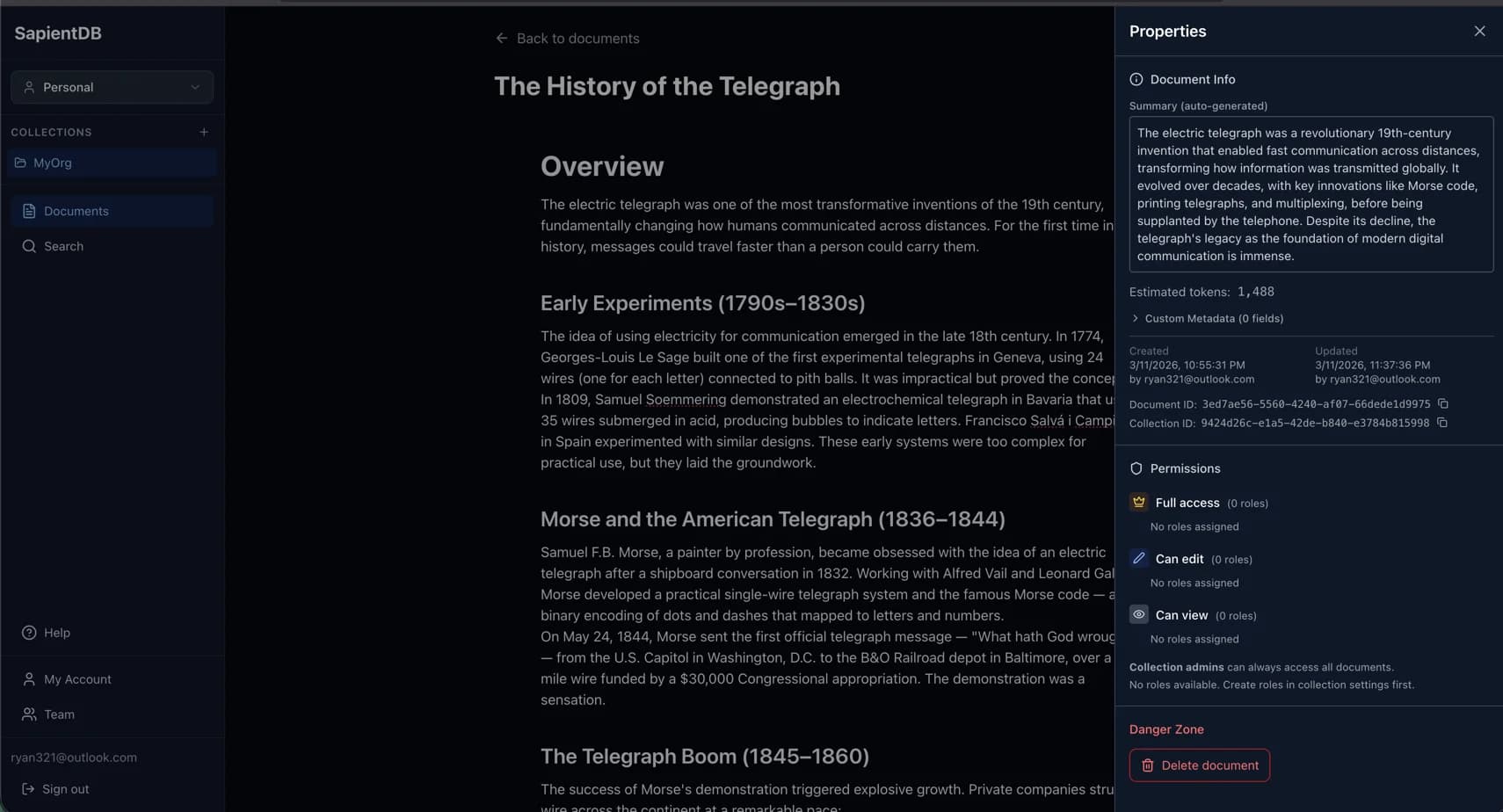
Markdown is the universal format
Every other storage layer invents its own format. SapientDB uses markdown—the format agents already write and humans already read. No custom schemas, no proprietary formats, no lock-in.
Human-editable
Open any block in a rich text editor. Headings, lists, code blocks, tables—all standard markdown.
Agent-friendly
Agents already think in markdown. No serialization layer, no format translation. Read and write directly.
Search-native
PostgreSQL full-text search over markdown content. tsvector indexing on every block, with token-budgeted results.
Version-safe
Every block edit is versioned. See who changed what. Diff at the paragraph level, not the file level.
File-level storage is broken for agents
Wastes tokens
Agents load 10,000 tokens to edit 50. Every file read burns context window on content the agent doesn't need.
Destroys edits
When an agent rewrites a file, it overwrites everything. No way for agents and humans to work on the same content safely.
All-or-nothing access
Files are permissioned at the file level. You can't let an agent write one section while protecting the rest.
SapientDB fixes this. Blocks are the contract—the interface agents and humans share. Not an implementation detail, the unit of access.
Four layers of permissions, enforced in PostgreSQL
Not in application code. Row-Level Security policies enforce every check at the database level. Even a compromised app server can't bypass them.
Organization
Multi-tenant isolation. Each org has its own collections, members, and billing.
Collection
Group documents by project or team. Assign roles with read, write, or admin capabilities.
Document
Per-document ACLs. Control who can see and edit each document independently.
Block
The finest grain. Grant access to individual paragraphs. Agents edit their blocks, humans edit theirs.
Service accounts
Create scoped credentials for each agent. Read-only, read-write, or admin. Revocable instantly.
Platform keys
SaaS integrations get platform-level API keys that can provision orgs, collections, and service accounts programmatically.
Full audit trail
Every action logged—who changed what, when, from which IP. Know exactly what each agent did.
Two interfaces, one database
Agents and humans see and edit the same live markdown blocks. No sync layer. No conflicts.
For AI Agents (MCP / API)
Connect via MCP
Add SapientDB as an MCP server in Claude, Cursor, or any compatible client. Or hit the REST API directly.
Search with token budgets
Full-text search returns relevant blocks within a token budget you specify. No wasted context window.
Read & write blocks
Fetch blocks by ID. Create, update, or append atomically. Every change is versioned and attributed.
Scoped permissions
Service accounts control exactly what each agent can see and do. Read-only agents can't modify content.
For Humans (Web Editor)
Rich markdown editing
Every paragraph is a live, addressable block. Headings, lists, code blocks, tables—all rendered inline.
Organize into collections
Group documents by project, team, or topic. Invite members and assign roles per collection.
Review agent work
See what agents wrote, when, and from which service account. Edit their markdown in-place.
Manage permissions
Create custom roles, set block-level ACLs, invite collaborators. Control who can do what at every level.
Connect your agent
Download the skill file and give it to your agent. It contains everything needed—MCP server config, all 17 tools, setup for Claude Desktop, Claude Code, Cursor, and any MCP client.
Place in your project root. Your agent reads it, installs the MCP server, and connects.
Built on real infrastructure
Not a toy. PostgreSQL with Row-Level Security, GIN indexes, tsvector search, and ACID transactions.
Token-budgeted search
Agents specify a token budget. Search returns the most relevant blocks that fit, ranked and truncated automatically.
Auto-summarization
Blocks and documents are automatically summarized for faster search and discovery. Summaries update when content changes.
Block versioning
Every edit creates a new version. Diff at the block level. Know exactly what changed and who changed it.
Multi-tenant SaaS
Organizations, collections, custom roles, member invitations. Platform keys let you provision tenants programmatically.
Cursor pagination
Agents paginate through large result sets without missing or duplicating blocks. Stable cursors across updates.
Self-hostable
Run on your own infrastructure. PostgreSQL is the only dependency. Docker, Fly.io, or bare metal—your choice.
What people build with SapientDB
Agent knowledge bases
Persistent memory agents can search, read, and update. Knowledge that grows with every interaction, reviewable by humans.
Collaborative writing
Humans outline in markdown, agents draft sections, humans review and edit—all in the same document. No file conflicts.
Multi-agent workflows
Multiple agents work on different blocks of the same document. Block-level permissions prevent them from stepping on each other.
Living documentation
Agents update individual markdown sections when code changes. Humans review diffs at the block level, not the file level.
Research & analysis
Agents collect findings into structured markdown blocks. Humans browse, search, and synthesize across collections.
SaaS integrations
Platform keys provision orgs and service accounts via API. Embed SapientDB as the document layer in your own product.